If I may, I would like to run an idea past the users of this forum, and ask if it is feasible/sensible/nuts.
These days I work as a psychotherapist, and I have been considering making a resource for patients that would be a hypertext “story” going from problems they might have through the consequences/lived experience/effects of such problems, their causes, and potential solutions. I thought it might be useful to some patients if they could click through to individual pages with explanations and further thoughts, rather than having walls of text. I suppose I have in mind that aTbRef does something not wholly dissimilar in a different subject area.
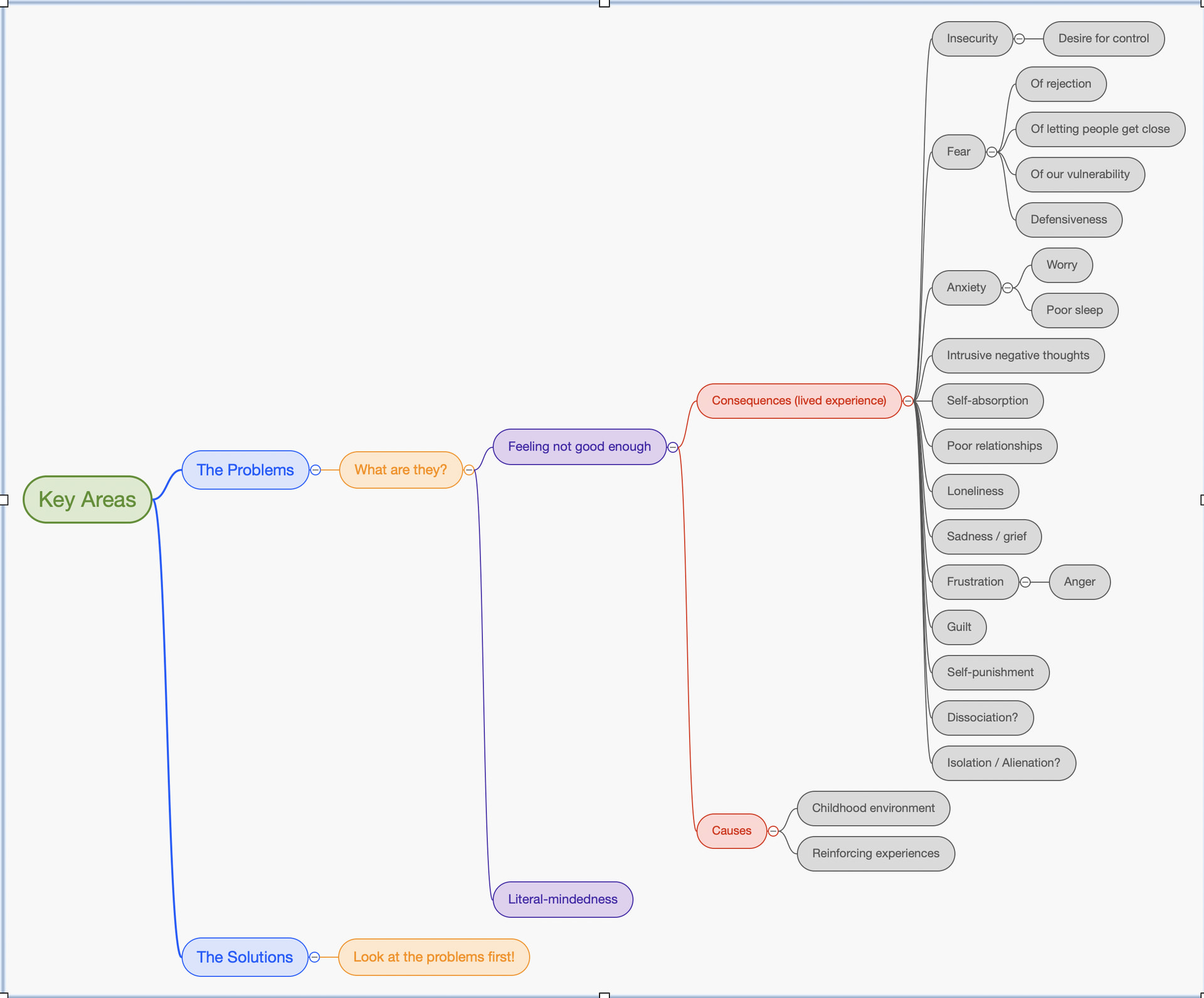
Does this seem a sensible thing to attempt in Tinderbox? I’ve attached a mind map to give an idea of what the “sitemap” might be like.
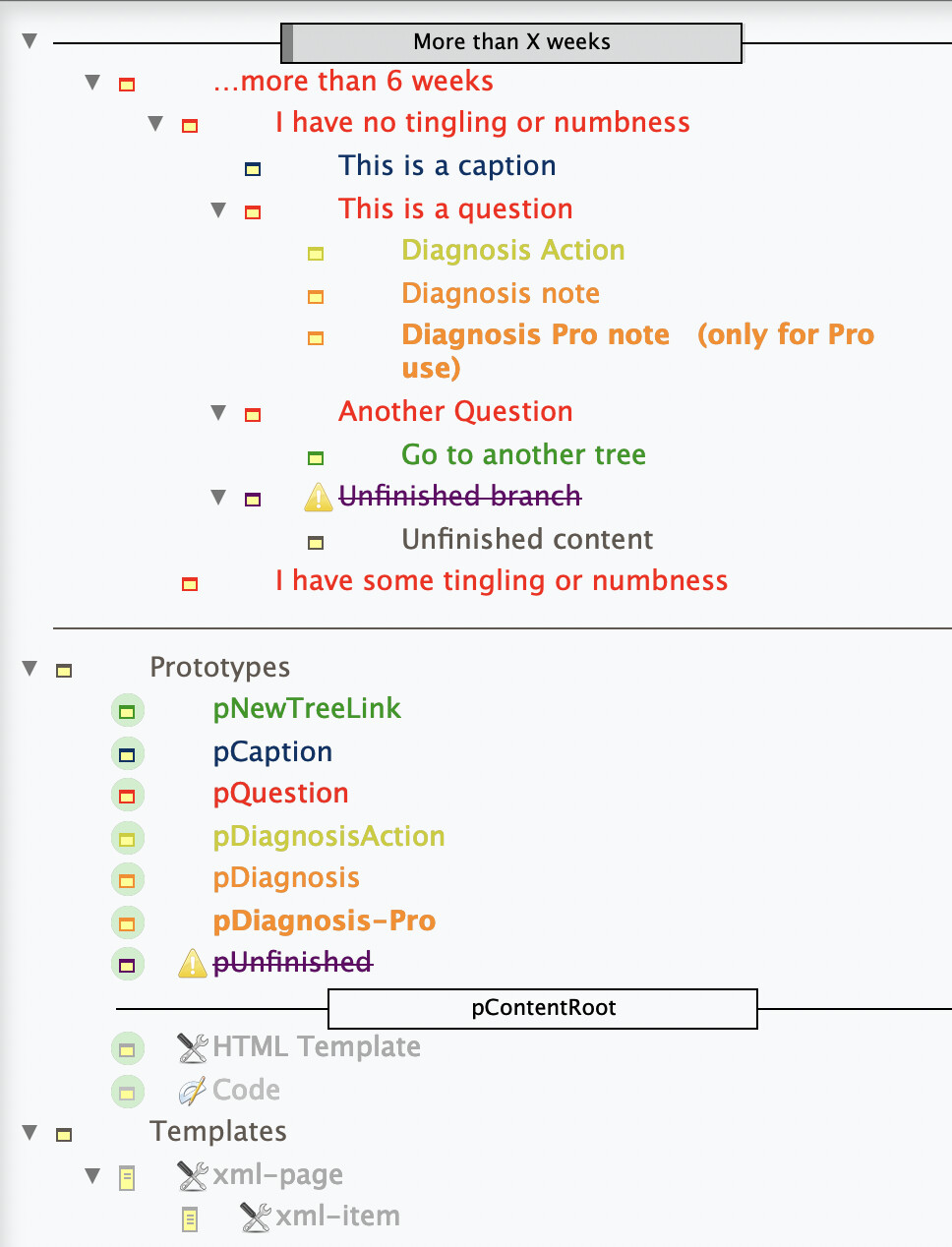
I remember helping two physiotherapists doing something similar back c.2012 with a physio triage system. Plotted out in Tinderbox 5, a single outline of some c70k notes. In fact, so big that at the time it broke the older (v5 era) design! It seems the product got built, funded, … and gone bust in the interim!
But building a static triage tree off a TBX outline is reasonable trivial. For the planning, remember : you can’t show what your don’t have, in terms of information. Part of the hard work is easily stage iterating over the metadata (attributes/values) needed.
The templates remind me the original plan was tp make a static HTML size but the size meant a pivot to generating XML to use in [unknown downstream system].
Many thanks Mark. Glad to know I am not too far off in my assumptions.
It looks like that old site is many orders of magnitude more complex than what I have been pondering. I can imagine needing a couple of hundred notes, but it would not surprise me if I needed fewer, nor would I be surprised if I ended up with double that. But thousands? No chance!
I toyed with the idea of using pdf, but I would like to create a kind of “pathway” that a person can follow, so that they understand the steps and processes involved in the working of the mind as it applies to them. Psychotherapy is more of an art than a science (in my view) and the medical model doesn’t really fit (my personal view, once again). Finding the right tool to make it accessible is a challenge. I have patients who are dyslexic and find reading difficult, so I’m also thinking of them when it comes to ways of structuring the resource.
Thanks again for sharing your knowledge and expertise.
I think your considerations make sense, especially with respect to unseen limitations like dyslexia. Well-formed HTML is very flexible as text and document semantic structure are both present and discretely stored. Thus a second-level headings text (content) is wrapped by <h2>...</h2> tags (semantic structure). CSS styling allows a whole rage of presentational option that can address accessibility/comprehension issues.
As un-seen challenge of PDF is it puts you back in Printocene-era thinking and the false tyranny of the page, which is self-defeating for digitally native text. A modular approach is warranted here, though (recalling the above project) care needs to be given to the length of the question chain. There will be a number, N, where the user gives up due to lack of progress and ‘too many’ questions. Still I think, with care a triage tree can work.
Even if not used directly as HTML, such output can easily be consumed by today’s app, e.g. for use on a phone or tablet. Also, Tinderbox has very flexible support and were a developer to ask you for, say, Markdown or XML or whatever, if it is a text based format Tinderbox can likely do it (even if you might need to get some templating advice—but the forum’s here!)
There are no questions here, because this is not a triage tree, in the sense that there is no diagnosis or final result to be arrived at. There is only information, interpretations, and ideas to be absorbed, chewed over and digested – though I believe that a certain path through the ideas may be useful. A certain concept, when understood, may make another concept easier to grasp. Hence my thinking that hypertext could facilitate leading a person along a particular pathway of concepts.
My mistake! I’d agree that a resource offering a path through helpful ideas ought to be of use. Plus, by cross linking notes in the outline you can have multiple paths through the corpus—especially if interested for self-exploration by the reader.
Can I ask you how you deal with uploading only changed notes to the web? Claude has put together some templates for me, but exporting the whole resource every time there is a change to any note could get a little tedious. I apologise if I’m asking something obvious and well-documented. Now I think, I should probably have asked Claude …
If exporting the whole document to HTML (i.e. suppressing export of unwanted parts) this generates the whole website on disk, as you note. Having done this once, to update one or several notes, select them and from the File menu click Export Selected Note(s). On the chooser dialog that opens simply click Export and Tinderbox will save the note(s) to where they need to go in the exported site’s files. This automatically overwrites a pre-existing version of the HTML page(s). The updated page can now be uploaded or synced to your web server.
FWIW, the latter is exactly what I do for small edits to aTbRef pages.
First, this project sounds like a lot of work, but a real treasure when it is complete!
I can see how curating the path through the links could be important for your topic. Storyspace shines in this regard, allowing the creation of gates to Tinderbox’s hyperlinks. I’m awaiting the impending release of Storyspace 4.