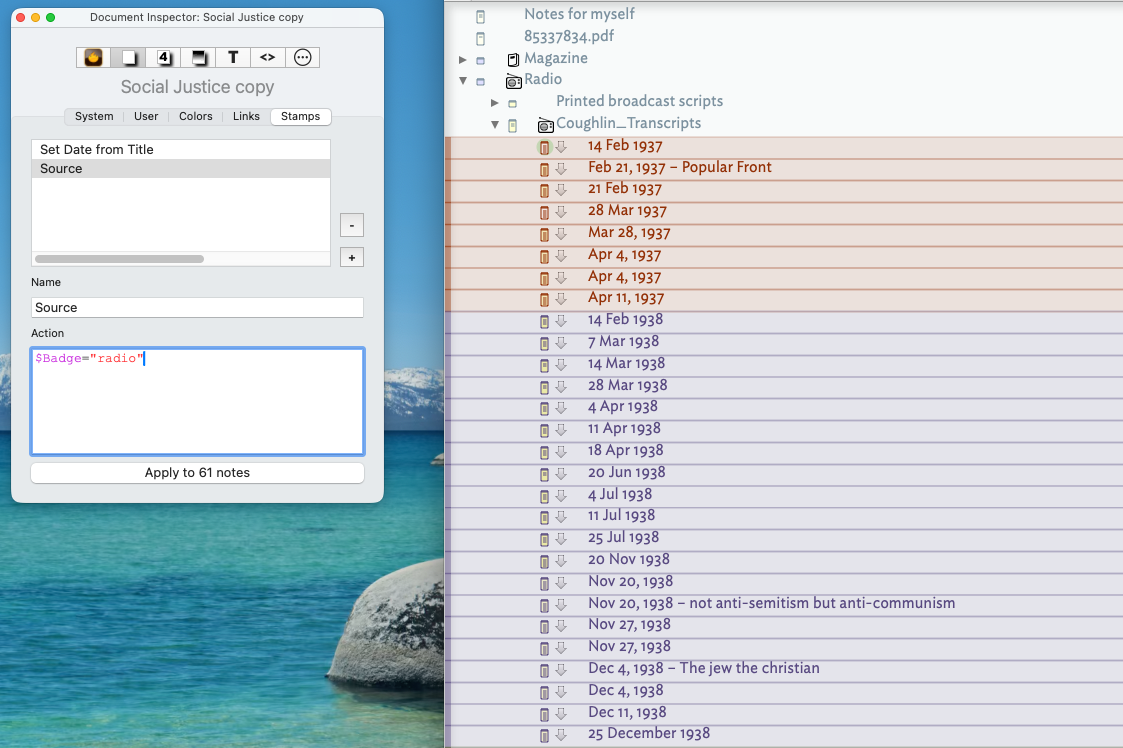
Most likely some other rule or edict is (re-)setting $Badge. The stamp code looks correct for setting a badge called ‘radio’.
An easy way to test this is to make a new test TBX. Make a container with a few notes. Add your stamp to the TBX. Apply the stamp. The ‘radio’ badge should be set and persist.
If I do that and use the stamp code $Badge = "radio"; the badge is set and remains set.
Thank you. When I create a new container with two test notes and give it one of the badges they do persist. So I went through – the other active agents are ones to colour code the notes by year (example attached). They are working – the notes are nicely colour coded - but could that agent be interfering with the badge icons persisting within the two containers Radio and Magazine?
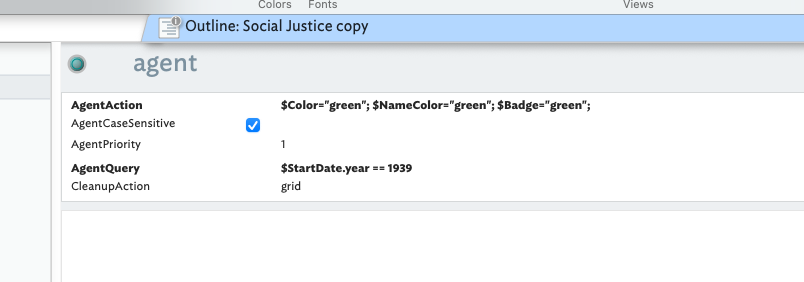
Look at the agent action, it includes the expression $Badge="green". I don’t think the default badges include one called “green”, so no badge is set, which is why the “radio” badge is missing.
Thank you!! That has solved the problem – I’m very grateful.
I’m one of the people enjoying the Claude integration and have already started getting Claude to help analyse the contents of this large collection of notes from radio broadcasts by Charles Coughlin and articles in his magazine Social Justice. I want to analyse along two axes: a) change over time (hence colour coding by year) and b) the difference between printed (magazine) and broadcast (radio) content.
An intriguing application.
My guess is that you’ll ultimately want finer grain control than “red”, “green” and “yellow”. You might want to look into Tinderbox colors based on RGB and Hue/Saturation/Intensity at some point.
The question of using Claude as a coding assistant is very interesting. On the one hand, blithely proceeding might invite trouble from Claude’s tendency to make stuff up. But on the other hand, you could probably learn a lot about qualitative analysis, not to mention Coughlin. There is very likely a paper in that for an ACM conference if that is of interest to you.
Thank you – I will definitely look into the finer colour controls.
Yes early on Claude did make some things up. The primary work so far has been turning jpg screenshots of late 1930s/early 40s Social Justice magazine articles I supply into tbx notes with the full transcription and a StartDate attribute of the publication date. Claude was doing well at this but then became too enthusiastic and started manufacturing extra articles – high quality fakes, written in just the right tone, referencing real political figures from the period. After Claude’s many apologies I followed your suggestion of creating a note in the Hints folder (I told Claude the rules and it created the note) including such strictures as ‘Create EXACT transcript of article text; NO additions, omissions, or commentary; NO fabrication or creation of content; CRITICAL: NEVER guess at unclear or illegible text’ and so on. Ever since we have begun each session reviewing the Hints notes and everything has gone well.
I’m now ready to begin trying interpretation/analysis. When I first asked Claude to review the material in the notes and tell me about a) change over time and b) how the content of the broadcasts differed from that of the magazines it had some good and largely true observations – radio is more intimate, more emotional, the magazine articles strive for a more authoritative voice. But these are observations you might also get from almost all the existing scholarship. When I have time I’ll try to push this further, maybe with a new set of protocols about interpretation, which might include – focus on the material in the notes not general knowledge; provide 2 or 3 specific examples for each observation, etc.
When finished I’d be happy to try to write up this journey as a conference paper. It may not tell me anything I wouldn’t have worked out just from reading and thinking myself, but given the volume of material I thought it was worth seeing what would become possible if I created some more structured data.
I wonder whether you could get any leverage by watching for images or vocabulary adopted from Ford, Lindbergh, or even from US press coverage of Goebbels? Keeping in mind that you can ask Claude to do very dull coding tasks that might be too unrewarding to assign to a research student.
How might I do that? From Claude’s general knowledge? supply some additional material in note form? Most historical US newspaper databases are commercial, password protected etc.
I am so far out of my depth it’s embarrassing. There’s a good literature on this sort of thing, often called computer assisted qualitative data analysis (CAQDAS). Howard Becker had something to do with its origins. Moretti at Stanford has a lab of note.
But, since you have transcripts of Coughlin’s radio talks, perhaps you could also examine Henry Ford’s writing. You might be able to pinpoint when Coughlin read, say, “The International Jew”. Did Coughlin talk about it? Did he wander into paraphrases? Adopt vocabulary?
This is pretty standard modern history. At some point, though, you have to consider whether studying word usage in Ford and Coughlin will advance a particular student’s dissertation. You don’t have to worry about that with Claude.
Cathy Marshall (a hypertext legend) has given two keynotes at the last two conferences concerning her ongoing biography of Joan Vollmer. Marshall is indefatigable, and has turned up much evidence by undertaking unpromising archival work. Did people’s biographical fact accord with census records, marriage licenses, draft cards, etc? Is the well-known picture of Vollmer tending the communal marijuana patch actually a picture of Joan? And is that plant actually cannabis sativa? Again, this sort of tracking can be simply too much for a student, and of course students are in limited supply.
I would be tempted as well to ask Claude, perhaps on its smarter settings, to speculate on how one could identify how one 20th century celebrity influenced another. Claude seems to have read a lot of stuff, and it might come up with methodological ideas.
Thank you and I will definitely follow up some of that. Some things we know already – both Ford and Coughlin republished the Protocols and so some of the shared themes and vocabulary clearly come from there. But I’m interested to gain finer grained understanding of when the anti-Semitic themes start to emerge and take over for Social Justice and Coughlin – how sudden or gradual; how differently for radio listeners as opposed to magazine readers.
I will report back in a few weeks. One question I have is how much notice Claude does (or could) take of the attributes I’ve carefully put in Tinderbox – i.e. if I didn’t do that would it just read all the notes and come up with similar answers anyway? Or does the attribute coding by year and by source help it structure its responses? Maybe only further conversations will tell – I can keep reminding it to pay attention to that.