Managing research notes, ideas, and project information can become challenging when working on multiple projects. Using structured notes, meaningful tags, links, and visual organisation can make information easier to retrieve and connect.
I’m interested in learning how others organise large collections of notes and maintain relationships between related ideas.
What methods or tools do you find most useful for knowledge management and long-term research projects?
It really helps to have more detail on what you have in mind. For example:
A paper for a computer science conference typically runs about 7000 words. It will have perhaps 15 references, though 50 is not unusual and @mwra has hit 250. It typically represents about a year of research performed by 1-4 people. That’s a lot of notes.
A New York Times Magazine feature might run about 8000 words and about 5 photographs, which would be selected from perhaps 200 images. It might be backed by perhaps a dozen interviews, and notes on a variety of books and articles. That’s a different lot of notes.
My weblog has 14,522 notes and 1.1M words. That’s a different lot of notes.
The Tinderbox file for my next book currently weighs in at 1,101 notes and 109,000 words. But the research for the book is very far from complete, and I have scarcely begun to write.
The Tinderbox development roadmap has 6,633 notes and 1.1M words, A typical note might be named “return in an action” with the text
“In an action (not a function), return should simply terminate the action.”
A novel runs to about 100,000 words, with perhaps 25 characters (each with their own backstory) and a dozen settings. A D&D campaign is easily that size, and is likely to have more world-building.
Location scouting for film, or managing film continuity, both require indefinite amounts of notes.
Then there are tasks. with, say, half a million entities for which only a database will do.
So, it helps to know more about the specific tasks you have in mind.
aTbRef is generated from a Tinderbox (TBX) file with 3,383 notes and 480k+ words, accrued over 2004 to the present day.
A research source file about papers in the ACM Hypertext conference, also used to generate all sorts of data files (CSV, TSV,JSON, BibTeX, etc.) as well as some LaTeX, has 12,931 notes and 452k+ words. Created 2018-2020 and incremented annually for each year’s conference. Core material is c.1.7k published items and c3.1k authors.
I use prototypes deliberately and widely. Effective use comes with practice, applying the learning of how they work to gain an understanding moulded to one’s own work and style. That might suggest wasted effort, but the flexibility of Tinderbox’s inheritance makes restructuring simple whilst at the same time gently educating the user in the power of attributes (metadata). It also means significant apparent change can be made to the presentation of your note without significant—if any—change to your notes. That degree of flexibility is not common in writing tools.
My documents are as much for research as writing, so often there are thousands of notes but very little note text ($Text) as the weight of the work is metadata, per-note (user) attributes. Going direct to attributes is learned efficiency. More commonly such information arrives textually and it manually or automatically extracted into attributes. Retaining text now is a matter of style and methodology, plus the fact the text may still retain facts not saved as metadata.
Why ’ learned efficiency’? For analysis, there tends to be a lot of querying and, in views, thematic (re-)presentation. You can’t query what you can’t define as a query. So things you know you will want to query gain by being discretely accessible as opposed to having to be laboriously mined from text using regular expressions. Also facts may only be implied in textual source but not stored as addressable facts. Thus, one of my doctoral research TBXs had 2,483 notes and only 75k words: the meat of this was 1.1k notes each of which had 30 user attributes but little if any text. Another: 8,678 notes, only 13k words with most info in c.20 user attributes.
Even if working only in-app, some views give of their best if a note has more than just title ($Name) and text ($Text).
As you will note from threads here, there is rarely a ‘right’ way to do a task, though there may be numerous sub-par approaches. Best fit turns out to be quite individual even for two users working in a similar field. What trips up many new starters is trying to recreate the ‘look’ of another user’s TBX without engaging with the structure (q.v. points above) that enables such display. Put another way a display of User B’s data that looks like User A’s might best be constructed a different way reflecting A’s and B’s differing style and task.
I think the Mark Anderson para quoted below is important. It deserves a more extended treatment with an example or two. Would you be able to do that? I am seeing a universe of TBX notes that is $Text-light and attribute-heavy. Among other things, to me this implies the maintenance of a universe of source texts outside TBX. What organizational principles ought to be observed in this multi-agent, multi-sourced world? Smarter people than me have already seen this I am sure.
I’ve post-op family caring duties in coming weeks so demos might have to wait (nothing scary, but why I’m around less).
To flesh out my last, I’m revisiting some PhD research by way of a longitudinal extension. I’m looking at whether Wikipedia users who wanted help bot help (i.e. from human bot operators, fellow wikipedians) actually di. It’s harder to parse than AI-boosters might imagine as wikipedians are reassuringly humanly anti-pattern behaviour in a bewildering number of ways. It really does pay to look at the data object … once at least. Scripting/automation only makes sense once the pattern of automation can be discerned.
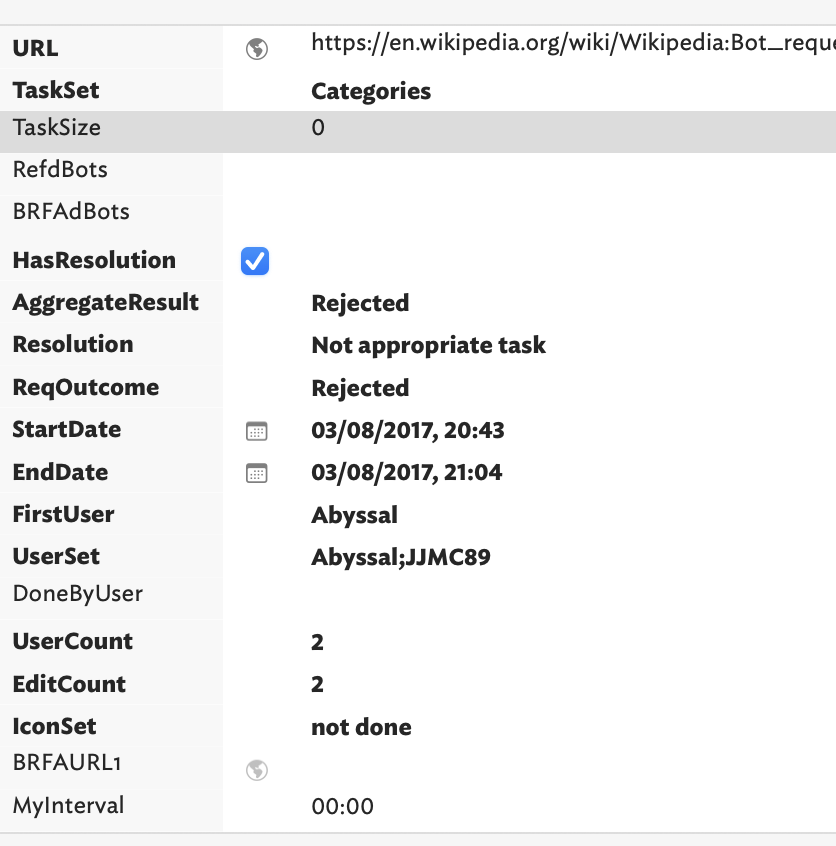
So, 'm looking at archived pages like this. I have notes like this, one per archived discussion:
$URL: opened the above page at the #-marker for the conversation
$TaskSet: a Set-type of the one of more discrete tasks being asked for
$TaskSize: number (count of $TaskSet)
$RefdBots: a Set-type of all Bot (accounts) discussed in-thread
$BRFA’dBots: A Set-type of all Bot (accounts) submitting task approval as a result of the thread
$HasResolution: Boolean if thread notes a resolution. Usually not for BRFAs as such tasking completion isn’t reported in thread. This attribute indicates unresolved threads.
$AggregateResult: String description summarising outcome
$Resolution: String indicating nature of result
$ReqOutcome: Set of outcome(s) od discussion
$StartDate: date/time of original request
$EndDate: date/time of last comment in thread
$FirstUser: account user name of person starting thread ( the request)
$UserSet: a Set of all discrete users participating in thread
$DoneByUser: User/bot-operator account taking tasking (or closing/rejecting it)
$UserCount: number of discrete users in thread
$UserSet: Set of all user account names in thread
$IconSet: a Set of all the different status icons used in the thread
$BRFA1/$BRFA2/$BRFA3: URL(s) of bot request (BRFA) raised as a result of thread
$MyInterval: duration of thread (difference of Strat/End data/times.
There are actually more user attributes (each with a saved description—we forget really quickly) and all are filled out for each of the 5.5k+ individual requests. Occasionally in-progress and at end AB View is used to look for miscompletions/typos, etc. At last the overall analysis can begin!
For a $Text-light, attribute-heavy setup, I’d distinguish three layers: an immutable source record per external item, an analysis/claim layer, and an output layer. Give each source a stable ID or URL, then use prototypes to enforce a small typed attribute set rather than repeating source prose. Analytical notes can link to that source record; outputs query both. This keeps the TBX file focused on relationships and metadata while source texts stay outside. It also makes later restructuring safer, because changing presentation doesn’t require rewriting note text.